Chapter 2 Euclidean Space
2.1 Algebra: Vectors
2.1.1.
Write down any three specific nonzero vectors , , from and any two specific nonzero scalars from . Compute , , and the additive inverse to .
Solution:
Let
2.1.2.
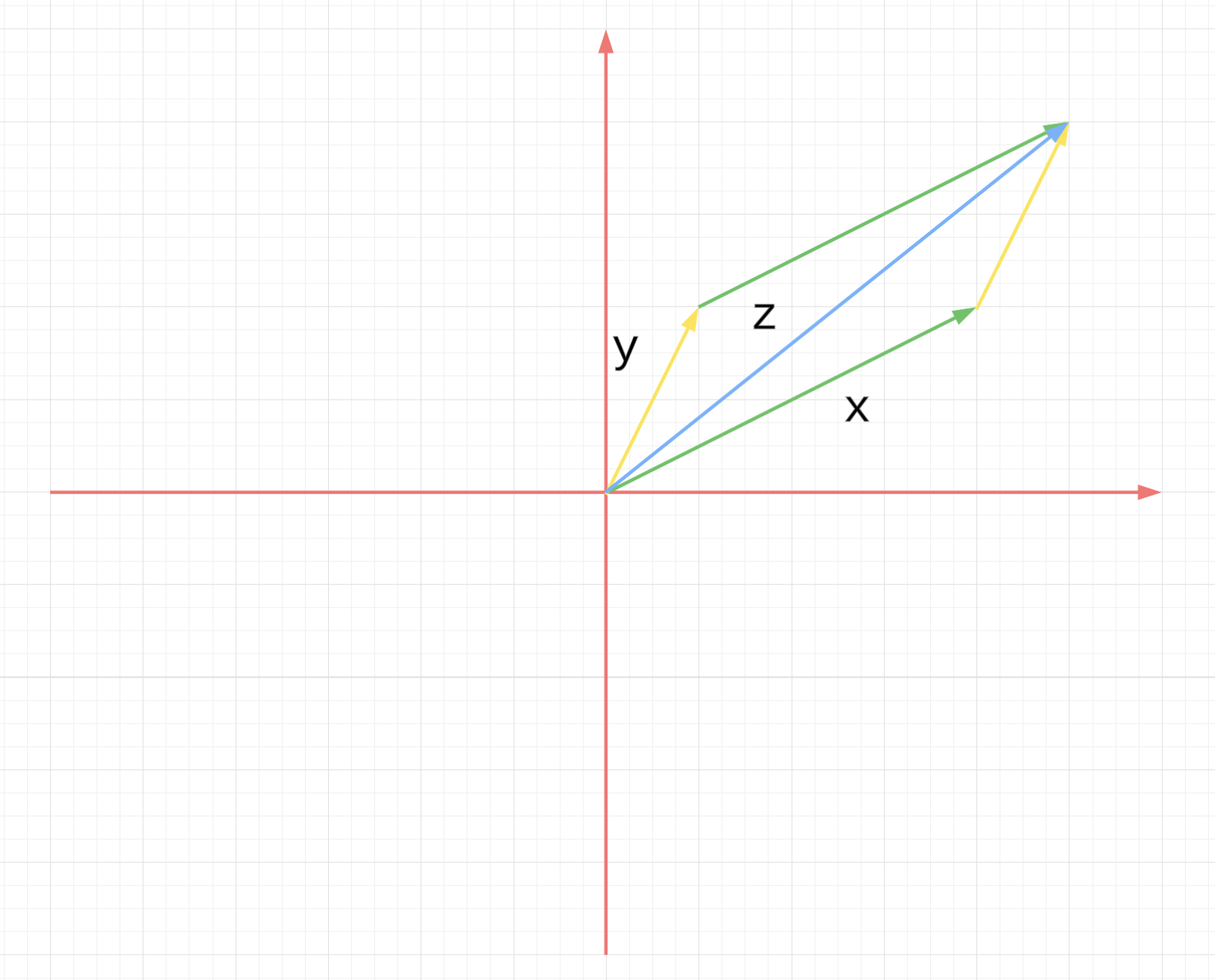
Working in , give a geometric proof that if we view the vectors and as arrows from and form the parallelogram with these arrows as two of its sides, then the diagonal starting at is the vector sum viewed as an arrow.
Proof:
See the figure below.
2.1.3.
Verify that satisfies vector space axioms (A2), (A3), (D1).
Proof:
(A2) is an additive identity
(A3) Existence of additive inverses
Let and
So is the additive inverse of .
(D1) Scalar multiplication distributes over scalar addition
2.1.4.
Are all the field axioms used in verifying that Euclidean space satisfies the vector space axioms?
Solution: Let's check the vector space axioms one by one.
(A1) Addition is associative uses (Fa1)
(A2) 0 is an additive identity uses (Fa2)
(A3) Existence of additive inverses (Fa3)
(A4) Addition is commutative (Fa4)
(M1) Scalar multiplication is associative (Fm1)
(M2) 1 is a multiplicative identity (Fm2)
(D1) Scalar multiplication distributes over scalar addition (Fd1)
(D2) Scalar multiplication distributes over vector addition (Fd1)
So we can see (Fm3) and (Fm4) are not used.
2.1.5.
Show that is the unique additive identity in . Show that each vector has a unique additive inverse, which can therefore be denoted . (And it follows that vector subtraction can now be defined,
for all .
Show that for all .
Proof:
Assume is a additive identity and . Then , i.e.
So , so . And thus is unique.
Assume and is 's additive inverse.
So
The additive inverse is unique.
2.1.6.
Repeat the previous exercise, but with replaced by an arbitrary vector space over a field . (Work with the axioms.)
So is unique.
So the additive inverse is unique.
Then we can add on both side
2.1.7.
Show the uniqueness of the additive identity and the additive inverse using only (A1), (A2), (A3). (This is tricky; the opening pages of some books on group theory will help.)
Proof:
I cannot figure it for now.
The uniqueness of the additive identity. Assume and are 2 additive identities. Then
2.1.8.
Let and be noncollinear vectors in . Give a geometric description of the set of all linear combinations of and .
Solution: All the linear combinations of and form a plane that includes .
2.1.9
Which of the following sets are bases of ?
How many elements do you think a basis for must have? Give (without proof) geometric descriptions of all bases of , of .
Solution:
For , given , we have
Then we can have
So is a base.
For , it is note a base. For example can be expressed by multiple ways.
For
Then we cannot represent with .
For ,
We have
Then we have to have , so we cannot represent with .
For , it needs element for a basis.
For , if is a basis, then geometrically, they should not be in one line.
For , if is a basis, then geometrically, they should not be in the same plane.
2.1.10.
Recall the field of complex numbers. Define complex -space analogously to :
and endow it with addition and scalar multiplication defined by the same formulas as for . You may take for granted that under these definitions, satisfies the vector space axioms with scalar multiplication by scalars from , and also satisfies the vector space axioms with scalar multiplication by scalars from . That is, using language that was introduced briefly in this section, can be viewed as a vector space over and also, separately, as a vector space over . Give a basis for each of these vector spaces.
Solution:
For the first one
For the second one
2.2 Geometry: Length and Angle
2.2.1
Let
Compute
Solution:
2.2.2.
Show that the points form the vertices of a triangle in with two equal angles.
Solution:
2.2.3.
Explain why for all , .
Proof:
Note
2.2.4.
Prove the inner product properties.
Proof:
(IP1) The inner product is positive definite: for all , with equality if and only if .
It equals 0 only when .
(IP2) The inner product is symmetric: for all
(IP3) The inner product is bilinear:
2.2.5.
Use the inner product properties and the definition of the modulus in terms of the inner product to prove the modulus properties.
Proof:
(Mod1) The modulus is positive: for all , with equality if and only if .
if and only if .
(Mod2) The modulus is absolute-homogeneous: for all and .
So
2.2.6.
In the text, the modulus is defined in terms of the inner product. Prove that this can be turned around by showing that for every ,
Proof:
So the equation holds.
2.2.7.
Prove the full triangle inequality: for every ,
Do not do this by writing three more variants of the proof of the triangle inequality, but by substituting suitably into the basic triangle inequality, which is already proved.
Proof:
Note
2.
Note
And similarly
Combine these 2 together, we have
3.
This is similar to 2.
2.2.8.
Let . Prove the size bounds: for every ,
(One approach is to start by noting that and recalling equation (2.1).) When can each be an ?
Proof:
From the hint:
This equality holds when .
Note
This equality holds when only only one of is not .
2.2.9.
Prove the distance properties.
Proof:
(D1) Distance is positive: for all , and if and only if .
Note
The equality holds only when , i.e. .
(D2) Distance is symmetric: for all .
Note:
(D3) Triangle inequality: for all .
Note:
2.2.10
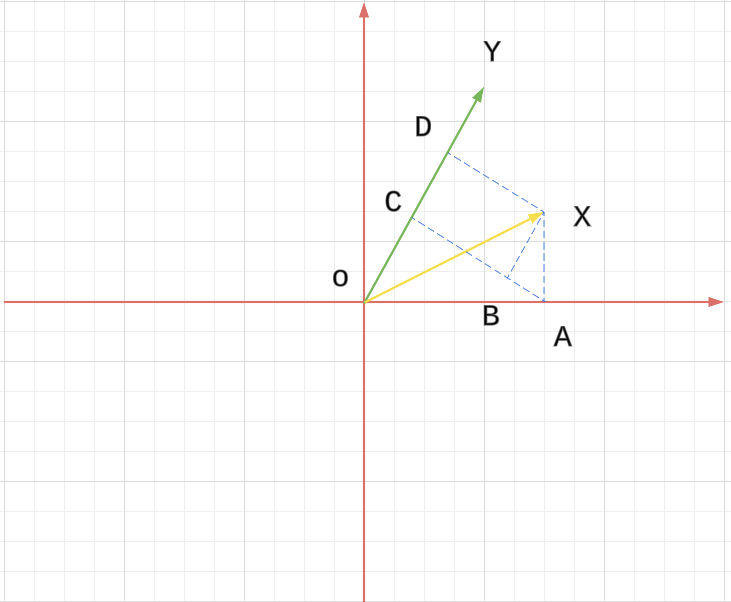
Working in , depict the nonzero vectors and as arrows from the origin and depict as an arrow from the endpoint of to the endpoint of . Let denote the angle (in the usual geometric sense) between and . Use the law of cosines to show that
Proof
Geometric proof:
As shown in the figure below, , and .
We just need to show
Note
Then we finished the proof.
Proof with triangle equalities:
Then
This also proved.
2.2.11.
Prove that for every nonzero , .
Proof:
2.2.12.
Prove that two nonzero vectors are orthogonal if and only if
Proof:
Then means .
2.2.13.
Use vectors in to show that the diagonals of a parallelogram are perpendicular if and only if the parallelogram is a rhombus.
Proof:
The 2 diagonals of the parallelogram are .
If , then , i.e. .
On the other hand, if , then .
2.2.14.
Use vectors to show that every angle inscribed in a semicircle is right.
Let on the semicircle, then .
consider
and .
Then
2.2.15.
Let and be vectors, with nonzero.Define the parallel component of along and the normal component of to to be
Answer:
(a) Show that . show that is a scalar multiple of . show that is orthogonal to . Show that the decomposition of as a sum of vectors parallel and perpendicular to is unique. Draw an illustration.
Proof:
Since is a scalar, then is a scalar multiple of .
So is orthogonal to , thus is orthogonal to .
In general if and , then
For the same reason .
With this, the decomposition of as a sum of vectors parallel and perpendicular to is unique.
(b) Show that
What theorem from classical geometry does this encompass?
Proof:
It's Pythagorean theorem or Gougu theorem.
(c) Explain why it follows from (b) that
with equality if and only if is a scalar multiple of . Use this inequality to give another proof of the Cauchy–Schwarz inequality. This argument gives the geometric content of Cauchy–Schwarz: the parallel component of one vector along another is at most as long as the original vector.
Proof:
This is because .
The equality holds when . In this case
To prove
Note
Now in general, if is a scaler, then
Then
(d) The proof of the Cauchy–Schwarz inequality in part (c) refers to parts (a) and (b), part (a) refers to orthogonality, orthogonality refers to an angle, and as explained in the text, the fact that angles make sense depends on the Cauchy–Schwarz inequality. And so the proof in part (c) apparently relies on circular logic. Explain why the logic is in fact not circular.
Solution:
Note that when we define , it is this:
But here, we define as
If we think geometrically in or , the projection of on should be .
The unit length vector along is . Also the length of projection is
So it's reasonable to define this way.
Now, since we does not rely on the fact that , it is not circular.
2.2.16.
Given nonzero vectors in , the Gram–Schmidt process is to set
Answer:
(a)What is the result of applying the Gram–Schmidt process to the vectors , and ?
Solution:
(b) Returning to the general case, show that are pairwise orthogonal and that each has the form
Thus every linear combination of the new is also a linear combination of the original . The converse is also true and will be shown in Exercise 3.3.13.
Proof:
First, we want to prove a small lemma: Given , if , then we want to show
Note
Then we can use induction. And assume
are orthogonal to each other. Assume ,
is proved in exercise 2.2.15.
Also, since for , then as just proved in the lemma.
So .
For the 2nd part, we can still use induction.
And assume for , they are all linear combination of .
Then
Note is a scaler of , thus a linear combination of .
Therefore, is a linear combination of .
2.3 Analysis: Continuous Mappings
2.3.1.
For , partially verify that is a vector space over by showing that it satisfies vector space axioms (A4) and (D1).
Proof:
(A4) Addition is commutative
Next,
(D1) Scalar multiplication distributes over scalar addition
2.3.2.
Define multiplication
Is a field with from the section and this multiplication? Does it have a subspace that is a field?
Solution
Define:
And is it's multiplication identity.
However, this function does not have inverse.
Consider
This is a field.
2.3.3.
For and define a subspace of the space of mappings from to
Briefly explain how this section has shown that is a vector space.
Solution:
It's stated in Proposition 2.3.7 (Vector space properties of continuity).
2.3.4.
Define an inner product and a modulus on by
Do the inner product properties (IP1),(IP2),and(IP3) (see Proposition2.2.2) hold for this inner product on How much of the material from Section2.2 on the inner product and modulus in carries over to ? Express the Cauchy–Schwarz inequality as a relation between integrals.
Proof:
(IP1)
It achieves 0 only when .
(IP2)
So IP2 holds.
(IP3)
First, we want to show
Based on the definition of integral, give a partition on .
So we have
Now
Also
All of the material from Section2.2 on the inner product and modulus in carries over to
Cauchy–Schwarz inequality
2.3.5
Use the definition of convergence and the componentwise nature of nullness to prove the componentwise nature of convergence. (The argument is short.)
Proof:
2.3.6.
Use the definition of continuity and the componentwise nature of convergence to prove the componentwise nature of continuity.
Proof:
Given any sequence , since is continuous at , then .
From Proposition 2.3.5 Componentwise nature of convergence .
So is continuous at .
Given any sequence , and since is continuous at , then .
From Proposition 2.3.5 Componentwise nature of convergence .
So is continuous at .
2.3.7
Prove the persistence of continuity under composition.
Proof:
Given , and . We have .
Since , and is a continuous mapping, we have .
Therefore, is continuous.
2.3.8.
Define by the rule
Solution:
It is continuous. Given any , if , we can always find a such that if , then .
Same thing when .
2.3.9.
Which of the following functions on can be defined continuously at ?
(a)
Solution
When approaches with , then
So it cannot be defined continuously at .
(b)
Solution:
When approaches with , then
So it cannot be defined continuously at .
(c)
Solution:
So it can be defined continuously at 0.
(d)
Solution:
When approaches with , then
However, when approaches with , then
So it cannot be defined continuously at .
2.3.10.
Let , where is continuous. Is continuous?
Proof:
Let , then is a continuous function.
Then from Proposition 2.3.8 (Persistence of continuity under composition), . So is also continuous.
2.3.11.
Let
such that and are continuous. Are
and necessarily continuous?
Proof:
No, it's not necessary. Consider the case when .
Then .
Then are continuous. But are not continuous.
2.4 Topology: Compact Sets and Continuity
2.4.1.
Are the following subsets of closed, bounded, compact?
(a) : not closed, bounded, not compact.
(b) :
closed, not bounded, not compact.
(c)
closed, bounded, compact.
(d) , where is continuous (this generalizes (b) and (c)),
Solution: Consider , since is continuous, . So . So it's closed. It can be either bounded or unbounded, so either compact or not compact.
(f) .
not closed, not bounded, not compact.
2.4.2.
Give a set and limit point of such that . Give a set and a point such that is not a limit point of .
Solution:
Consider , let , .
Let .
2.4.3.
Let be a closed subset of and let . Define the graph of to be
a subset of . Show that if is continuous then its graph is closed.
Proof:
Given , .
Let . Then from Proposition 2.3.5 (Componentwise nature of convergence), , and since is continuous . Also since is closed, so .
So .
Then is closed.
2.4.4.
Prove the closed set properties: (1) the empty set and the full space are closed subsets of ;
(2) every intersection of closed sets is closed;
(3) every finite union of closed sets is closed.
Proof:
(1) does not have limit point, so contains all it's limit point, which is nothing. 's limit points are in . So is closed.
(2) Let , is a limit point of . So we can find a , where . Then . So . Then .
(3) Let , is a limit point of . So we can find a , where . Then we can find at least one , such that there are infinitely many . It is a subsequence of and also convergences to . So .
2.4.5.
Prove that every ball is bounded in .
Proof:
Assume , then
2.4.6.
Show that is a bounded subset of if and only if for each , the th coordinates of its points form a bounded subset of .
Proof: We will need Proposition 2.2.7 (Size bounds)
2.4.7.
Show by example that a closed set need not satisfy the sequential characterization of bounded sets, and that a bounded set need not satisfy the sequential characterization of closed sets.
Solutions:
Consider which is a closed set. Let , then it does not have a subsequence that convergences.
Consider which is bounded. Let , we have .
2.4.8.
Show by example that the continuous image of a closed set need not be closed, that the continuous image of a closed set need not be bounded, that the continuous image of a bounded set need not be closed, and that the continuous image of a bounded set need not be bounded.
Solution:
Consider . which is not closed.
Consider . which is not bounded.
Consider . which is not closed.
Consider . which is not bounded.
2.4.9.
A subset of is called discrete if each of its points is isolated. (Recall that the term isolated was defined in this section.) Show or take for granted the (perhaps surprising at first) fact that every mapping whose domain is discrete must be continuous. Is discreteness a topological property? That is, need the continuous image of a discrete set be discrete?
Solution:
First we show a function is continuous at any point .
Give any , since is isolated, we must have for , then , which means is continuous.
Consider
and let . So is in , and is not isolated.
2.4.10
A subset of is called path-connected if for every two points , there is a continuous mapping
such that and . (This is the path that connects and .) Draw a picture to illustrate the definition of a path-connected set. Prove that path-connectedness is a topological property.
Proof:
Let is a continuous map. Given , we want to show is also path-connected.
From Proposition 2.3.8 (Persistence of continuity under composition), is a continuous map and
So is also path-connected.