Chapter 2 Finite-Dimensional Vector Spaces
2A Span and Linear Independence
2A.6
Show that the list is linearly dependent in if and only if .
Proof:
So . Then .
2A.7
(a) Show that if we think of as a vector space over , then the list is linearly independent.
Proof:
Assume
Then
So .
(b) Show that if we think of as a vector space over , then the list is linearly dependent.
Proof:
Note .
2A.8
Suppose is linearly independent in . Prove that the list
is also linearly independent.
Proof:
We have
2A.9
Prove or give a counterexample: If is a linearly independent list of vectors in , then
is linearly independent.
Proof:
2A.10
Prove or give a counterexample: If is a linearly independent list of vectors in and with , then is linearly independent.
Proof:
2A.11
Prove or give a counterexample: If and are linearly independent lists of vectors in , then the list is linearly independent.
Solution:
Counterexample:
Let
Then
2A.12
Suppose is linearly independent in and . Prove that if is linearly dependent, then .
Proof:
is linearly dependent, then we can find , not all , such that,
If , then , we have a contradition.
Then .
So .
2A.13
Suppose is linearly independent in and . Show that
is linearly independent if and only if
Proof:
We prove by contradition. If , then
So
Then we have the contradition.
We prove by contradition.
Assume is linearly dependent. Then
If , then is linearly dependent. We have a contradition. So . Then .
2A.14
Suppose is a list of vectors in . For , let
Show that the list is linearly independent if and only if the list is linearly independent.
Proof:
if
2A.15
Explain why there does not exist a list of six polynomials that is linearly independent in .
Proof:
spans . From 2.22, length of linearly independent list length of spanning list.
2A.16
Explain why no list of four polynomials spans .
Proof:
If a list of four polynomials spans , then
has to be linearly dependent, which is not the case.
2A.17
Prove that is infinite-dimensional if and only if there is a sequence of vectors in such that is linearly independent for every positive integer .
Proof:
We start with any . If we cannot find , such that is linearly independent, then spans we have contradition.
This step can continue, assume we find are linearly independent, since it does not span , we can find , then from exercise 2A.13, is still linearly independent.
We prove by contradition, if is finite-dimensional, then some list of vectors in it spans the space . Assume for this list has vectors.
But we can find are linearly independent, from 2.22, we have a contradition.
2A.18
Prove that is infinite-dimensional.
Proof:
We can construct a sequence
2A.19
Prove that the real vector space of all continuous real-valued functions on the interval is infinite-dimensional.
Proof:
We can construct a sequence
2A.20
Suppose are polynomials in uch that for each . Prove that is not linearly independent in .
Proof:
Since , we can write
And note . Since spans , then is linearly dependent. We can find
So
2C Dimension
2C.11
Suppose 𝑈 and 𝑊 are both four-dimensional subspaces of . Prove that there exist two vectors in such that neither of these vectors is a scalar multiple of the other.
Proof:
2C.12
Suppose that 𝑈 and 𝑊 are subspaces of such that , , and . Prove that .
Proof:
So . Then .
2C.13
Suppose 𝑈 and 𝑊 are both five-dimensional subspaces of . Prove that .
Proof:
So .
2C.14
Suppose 𝑉 is a ten-dimensional vector space and are subspaces of with . Prove that .
Proof:
2C.15
Suppose 𝑉 is finite-dimensional and are subspaces of 𝑉 with . Prove that .
Solution:
Exactly them as exercise 2C.14.
2C.16
Suppose 𝑉 is finite-dimensional and 𝑈 is a subspace of 𝑉 with . Let and . Prove that there exist subspaces of 𝑉, each of dimension , whose intersection equals 𝑈.
Proof:
Let be a basis of , and we extend it to a basis of by adding .
Consider the following subspaces
Since , the intersection W contains .
Assume , then it can be the linear combination of these basis. Since the combination is unique, the coefficients for has to be 0.
Then is in .
2C.17
Suppose that are finite-dimensional subspaces of 𝑉. Prove that is finite-dimensional and
Proof:
Just use induction and 2.43.
2C.18
Suppose 𝑉 is finite-dimensional, with . Prove that there exist one-dimensional subspaces of such that .
Proof:
Assume is a basis of . Let .
First , because is a basis.
Second, since is a basis, the representation is unique.
So .
2C.19
Explain why you might guess, motivated by analogy with the formula for the number of elements in the union of three finite sets, that if are subspaces of a finite-dimensional vector space, then
Solution:
Consider the following diagram.
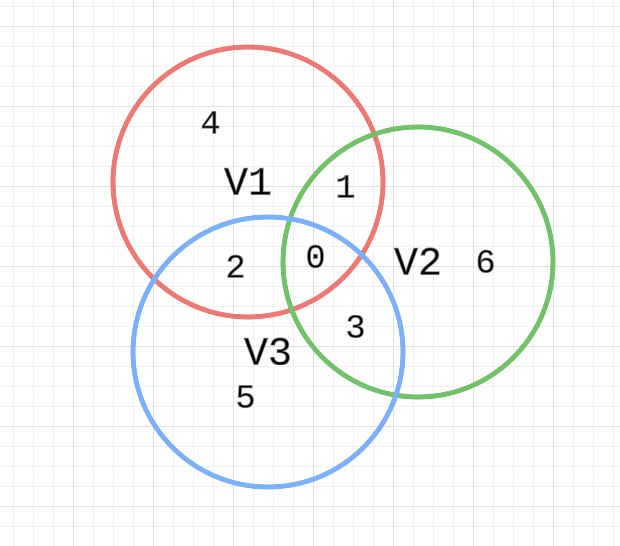
2C.20
Prove that if , , and are subspaces of a finite-dimensional vector space, then
Proof:
Again consider the diagram above